
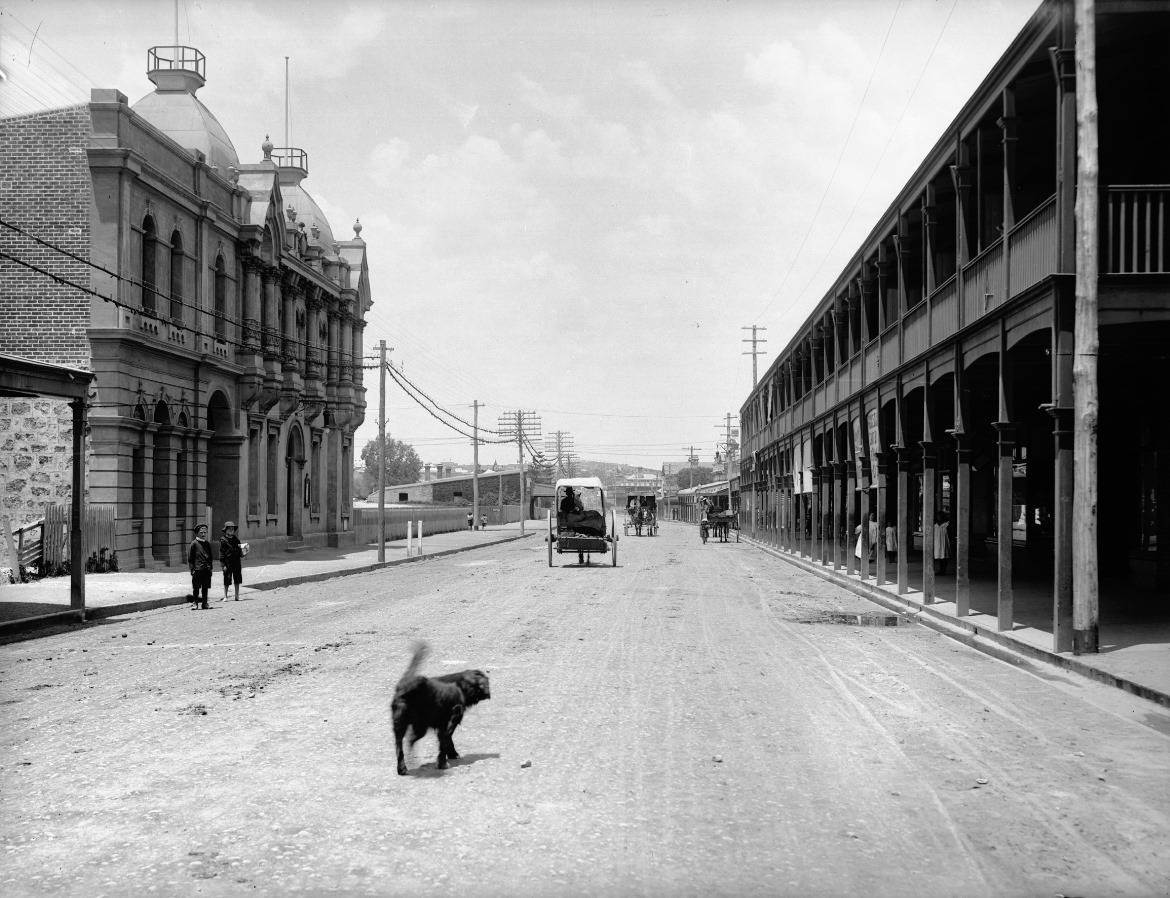
Victoria Avenue, North Fremantle, looking south towards the river, with the Town Hall at left. Courtesy State Library of Western Australia, 009205PD.
A wide unsealed street in North Fremantle in the late nineteenth century, with horse-drawn carts, a two-storey verandahed terrace on the right and the Town Hall on the left.
In 1877, a man was struck by a horse-drawn mail cart on a Fremantle street and died. He was elderly by then, and well regarded in the town. The response to his death was to introduce vehicular speed limits and compulsory lights for night driving — the first such rules Fremantle had.
His name was Moon Chow, also recorded as Chow Moon and 周满. He was Western Australia’s first documented Chinese resident.
Page One, Not a Later Chapter
The Swan River Colony was founded in June 1829. Moon Chow arrived within its first year, aboard the spice-trade ship Emily Taylor — sources differ on whether that was October 1829 or March 1830, which tells you something about how thinly this history was recorded at the time.
He had been hired as a ship’s carpenter in Bombay. When the Emily Taylor was damaged in a storm off Fremantle in May 1830, the crew found themselves stranded in a settlement barely a year old, without work.
Moon Chow stayed. He found employment with the colonial government as a joiner and carpenter, and by August 1830 was working for Henry Reveley, the Chief Civil Engineer responsible for the colony’s earliest public buildings. He was paid less than his English counterparts. His craftsmanship was valued regardless — he became known as a skilled boat builder, and built a five-oared whaleboat that was highly regarded at the time.
He married Mary Thorpe in 1847. They had children. He lived in Fremantle until his death fifty years after he arrived.
Why This Matters Now
There is a habit, when talking about multicultural Western Australia, of treating cultural diversity as something that happened to the state later. A post-war development. A recent arrival. A trend to be responded to.
The record does not support that. Chinese West Australians were present in the colony’s first year, doing the work of building it — and one of them changed the state’s road rules by dying on one.
That is not a footnote to Western Australian history. It is part of the founding-era record, and it has been there the whole time, largely unread.
What We Take From It
At Sensory Media, we work between Western and Chinese language and culture every day. It would be easy to describe that as a service responding to a modern market.
We would rather describe it as something older. The relationship between these communities in Western Australia is approaching two hundred years. It has produced tradespeople, business owners, families, public servants and community leaders continuously across that period — most of whose names were never written down as carefully as Moon Chow’s nearly wasn’t.
Bridging cultures is not a new commercial opportunity here. It is a long-running story that Western Australia has been telling since its first year, whether or not anyone was recording it.
We are glad to be working on the next chapter of it.
Know a Story Worth Sharing?
We welcome story ideas from individuals, businesses, community groups and organisations.
Perhaps you know an inspiring person whose contribution deserves greater recognition, a multicultural community story that has not yet been told, or an experience that could help others better understand a different culture, identity or way of life.
We would love to hear from you.
Share your story with Lucia Chen: lucia.chen@sensorymedia.com.au
Together, we can give meaningful stories a wider voice—and help build a more inclusive, connected and harmonious Western Australia.